“Now is the chance” – In search of the active lay judge
Stefan Machura, Yundong Luo & Christoph Rennig
Abstract
Lay assessors in mixed tribunals are required to take actively part in trial and deliberation. A perennial problem is that they are not sufficiently informed how they can contribute, and they are not always supported by the presiding professional judge. This text concentrates on the motivation of lay assessors at the German lower criminal court, called “Schöffen”. While many are aware that they must be prepared to have a discussion with the professional judge and stand their ground if necessary, some shy away from challenging the judge’s view. German law is contradictory on the point if candidates for the Schöffen office can be selected for their aptitude and qualification. The authors are drawing on the results of an empirical study of the behaviour of Schöffen and suggest there should be a discussion of the issue.
Laienrichter in gemischten Spruchkörpern sind verpflichtet, aktiv am Prozess und an der Beratung teilzunehmen. Ein bekanntes Problem ist, dass sie nicht ausreichend darüber informiert sind, wie sie beitragen können, und nicht immer vom vorsitzenden Berufsrichter unterstützt werden. Dieser Text konzentriert sich auf die Motivation von Schöffen an Amtsgerichten. Während vielen bewusst ist, dass sie bereit sein müssen, mit dem professionellen Richter zu diskutieren und – wenn erforderlich – eine andere Meinung konsequent zu vertreten, scheuen sich andere davor, der Meinung des Richters zu widersprechen. Das deutsche Recht ist widersprüchlich, wenn es darum geht, ob Kandidaten für das Schöffenamt aufgrund ihrer Eignung und Qualifikation ausgewählt werden können. Die Autoren stützen sich auf die Ergebnisse einer empirischen Studie zum Verhalten von Schöffen und schlagen vor, dass die Frage diskutiert werden sollte.
I. Introduction
Lay assessors who are joining a professional judge in a mixed tribunal take on an important but demanding task. They represent “the people” in the administration of justice which is otherwise dominated by professional players: judges, prosecutors, lawyers, and others. The mixed tribunal is presided by an experienced professional judge, in almost all countries with many years of legal training. The lay assessors do not necessarily, and almost certainly not at the start of their office period, know sufficiently about court procedure and the law applicable to the case at hand. Introduction events for them are short and usually not enough to prepare them for their function in a trial.
At numerous seminars for lay judges and in many publications, Hasso Lieber has emphasised that lay judges need certain qualities (e. g., Lieber 1999; Lieber and Sens 2024, 60). They must be prepared to form their opinion on a case with inner independence and where necessary to question the view of the presiding professional judge. Lay assessors should not avoid asking questions and must contribute to the panel’s deliberation. This requires character traits in candidates which do not preclude active participation. “Yes–men/–women” are not suitable for such an office.
II. Results of an empirical study: active and passive lay judges
As part of a research project on the cooperation of lay and professional judges at German criminal courts in the German Province of Hesse, we have conducted a workshop with Schöffen.1 “Schöffen” is the traditional German name for lay assessors at criminal courts. They hear cases together with a professional judge who presides over trial and deliberation. This type of tribunal is called “Schöffengericht”.2 One of the objectives of our study was to find out if Schöffen are unduly passive or too easily impressed by the authority of the professional judge. The workshop was attended by 12 serving Schöffen, sitting in adult and youth court. With permission, the group discussion was recorded. Names are anonymised in the following. At one point in the group discussion, a participant, Schöffe 3, demonstrated a passive stance and was criticised for it by his colleagues. Schöffe 3 had described that he has found the presiding judge to be open to the views of Schöffen, but then, the exchange of arguments makes him to profess to a rather passive attitude to his role in court.
Schöffe 3: So, when we do, we essentially always have one [presiding judge], uh, who is open to discussion. Um, I wouldn’t risk overruling him or responding with my female colleague on the fatwa3, um, we come, we are, mostly it’s always new ladies4 who come with us, then, and you don’t know them, and it’s just, as you all here have already said, you have to get to know each other first, there’s no time for that, so, I don’t risk it.
Schöffe 10: Well, I don’t really understand that.
Schöffe 3: So that we outvoted the judge.
Male Schöffe:5 Yes, but what if I disagree?
Schöffe 6: Yes, exactly.
Schöffe 2: Yes, if I think, I’m not arguing about a month or an imposition more or less, but if I fundamentally believe that it’s not true, then I have to go against it and, uh, then, uh, possibly demand a vote, hoping that my, uh, colleague will then agree with me or something.
Schöffe 3: Yes, I’m not as combative as you might be.
Schöffe 2: Me neither, no, I’m not, no, but, uh, but, uh, but that’s our job.
Female Schöffe: Yes, I think so too, that’s our job.
Schöffe 3: So, I’ll let go of the idea that I wanted to pick a fight.
Schöffe 12: I think it’s not seeking conflict, but rather a very clearly defined process.
Schöffe 10: Exactly.
Schöffe 12: I stand up for my opinion when I’m serious about it.
Female Schöffe: If you don’t argue and a vote is taken, you shake hands after the vote and then it’s all good.
(…)
Schöffe 10: But I think it’s absolutely crucial, honestly, that one is also aware of the impact of one’s, uh, opinion and the effect of one’s vote. Because that’s precisely why there’s a court of lay assessors, so that things are reviewed from a different perspective, and if you don’t agree, then I think it’s our damned duty to say: “Excuse me, I see this differently.” I find that fundamentally important for this job.
Schöffe 2: Besides, that’s our power, the power we exercise. And if I don’t exercise a power I have, then I’m still exercising it.
Schöffe 10: Yes, exactly.
Schöffe 2: So, by giving the other person space, or a different opinion, if I have a different opinion, I can say, you’ve always been in agreement, then that’s fine. It’s not about a contested vote, for the sake of the contest, right?
Schöffe 13: And I just have to be able to live with it if two people say, “Hop,” and I say, “Dopp,” then I’m outvoted, right?
Schöffe 2: Exactly.
Female Schöffe: Now’s the chance …
Other Schöffe: But I have to explain my point of view.
His words reveal that Schöffe 3 shies away from contradicting the presiding judge. In the workshop discussion, he senses that he is in a minority and declares: “I’m not as combative as you might be.” He says he avoids to “pick a fight”. The dissenting voices favour a more involved role of the Schöffen: they should be prepared to express a different view from that of the professional judge if required. In a memorable formulation, Schöffe 2 said: “if I don’t exercise a power I have, then I’m still exercising it”. In the words of a female colleague: “now is the chance” — to influence the outcome of a case.
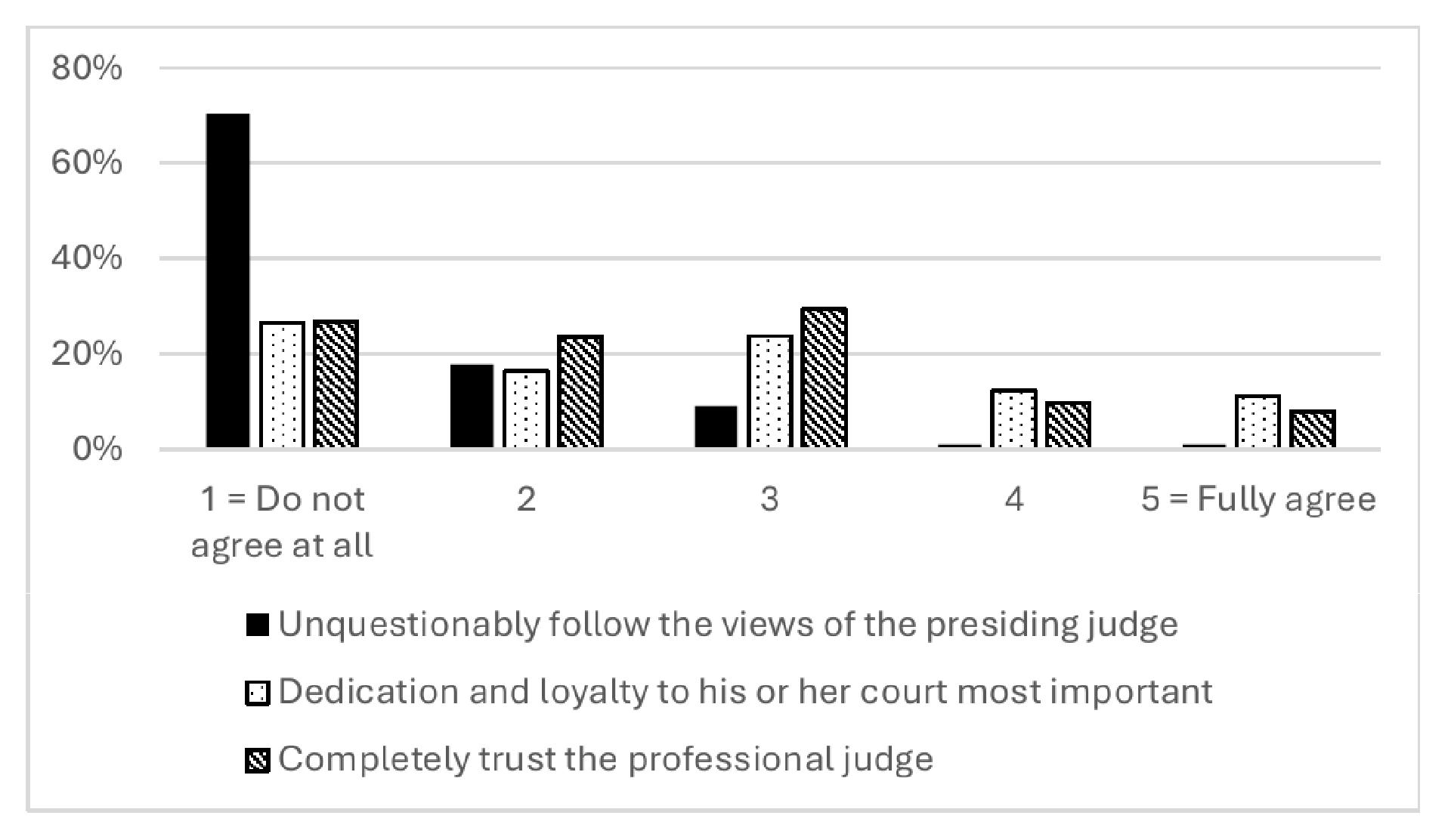
Note: n = 274, 275, answers on a five-point scale.
Lay judges should want to be active members of the judicial panel. If not, they fall short of the idea behind lay participation. We also have asked Schöffen at the lower criminal courts in Hesse province to complete an online questionnaire. It contained the three questions about the attitude to the office of a lay judge shown in Figure 1.6 While by far most of the Schöffen rejected the idea that they should follow the views of the professional judge without questions, the two other items had more mixed results. A fair number of the respondents sympathised with the statement that Schöffen should “completely trust” the professional judge. This attitude is problematic as judging requires – to borrow a term – “kompetente Skepsis” (competent scepticism, Wolff and Müller 1997). Schöffen should not trust blindly but need to be convinced before they decide. In a similar vein, not outright rejecting the statement “One of the most important qualities of a Schöffe is dedication and loyalty to his or her court” can indicate a problematic understanding of their function. The justice system requires Schöffen to be independent and if necessary, challenge the judge and court practices. In the group discussion, Schöffe 9 said that he wants a discussion with the presiding judge: “And then I can see certain things he argues differently, or not. And I say so when I ask, ‘Is that really how it is?’ and so on. And if the judge convinces me, then I go along with it. And if the judge doesn’t convince me, then I try to convince him. So, that’s it.”
III. Selecting Schöffen for aptitude
Hasso Lieber has plead for the selection of Schöffen to take into account their qualification. They do not need to be trained lawyers but when the municipalities and counties are putting together lists of candidates,7 what is known about their preparedness to become active office holders should be considered.
Unfortunately, German law is contradictory on this point. If Article 33 Section 2 of the Federal German Constitution, the Basic Law, is understood as the guideline for the selection of Schöffen, this would mean some contrast to Paragraph 36 Section 2 Sentence 1 of the German Courts Constitution Act. According to Art. 33(2), qualification has to be the criterion. It reads: “Every German shall be equally eligible for any public office according to his aptitude, qualifications and professional achievements.” In conversation with the authors, Hasso Lieber has taken the view that this constitutional requirement should guide the selection of Schöffen candidates.
However, § 36(2) of the Courts Constitutions Act only mentions representativeness as criterion: “The list of nominees should adequately reflect all groups within the population in terms of sex, age, occupation and social status.” Höland (2025, 195) notes that the “should” indicates a Sollvorschrift (in German law a legal provision that is not strictly binding). He adds that the formulation “is comparatively general and vague, its actual observance uncertain”. Empirical studies show that Schöffen tend to be older and presumably more middle class than the average citizen (Machura 2001, 176–179). Our current study in Hesse had only 3 % blue–collar workers among its respondents. Yet, gender parity is apparently more easily achieved.
The improved selection of lay judge candidates can be based on two decisions of the Federal Constitutional Court, in which the court once explicitly based the removal of an honorary (lay) judge from his office on his or her lack of suitability (decision of 06.05.2008 – 2 BvR 337/08 – para. 21) and in which it focused on the fact that a panel of judges dominated by honorary judges (which includes the Schöffengerichte) is then no longer a state court, if the honorary judges are overwhelmed with their task (decision of 30.05.1978 – 2 BvR 685/77, para. 94). Since lay judges’ courts must undoubtedly be state courts, it follows conversely that only those persons should be lay judges who are not overwhelmed by their office. In both decisions, the Federal Constitutional Court essentially relied on the fact that both professional judges, to whom Article 33(2) of the Basic Law applies, and honorary judges take the same oath in terms of content. According to the court, loyalty to the Constitution is an element of suitability for the office of both professional judge and honorary judge. Consequently, neutrality and objectivity must then also be regarded as an element of suitability. In any case, according to this, the suitability of a person may also be used as a criterion for the election of honorary (lay) judges.8
From a legal point of view the constitution supersedes the simple law. Yet, the question is, how to assess the qualification of persons applying for the office of a Schöffe? In larger municipalities and rural districts, it will certainly not be possible for the members of the committee putting together candidate lists to know all of them. However, on some candidates, there may be information. They may have been active in religious associations, in local charities, political parties and similar settings and committee members may have an idea about their personality’s suitability for the office. In our present study, we asked if the Schöffen participating were sitting on the board of an association or party, or were elected officials in a municipal, church or other bodies. 32.8 % did indeed. 7.3 % of the respondents had even served as another type of lay judge in the justice system, for example in labour courts, or as lay mediator (Schiedsperson).
Conclusion
Schöffen like all lay assessors in mixed courts need to be prepared to play an active role, a requirement consistently emphasised by Hasso Lieber. This includes aspects such as asking questions, forming their own opinion, entering into a dialogue with the presiding judge (but also fellow lay judges), voicing their view in the deliberation on the case and if necessary, advocating and asserting a different view. To make this more likely, introduction events and other training for the lay assessors should encourage them to contribute actively. And of course, professional judges need to support and enable their lay colleagues so that they are not locked into a passive behaviour pattern (e. g. Machura 2001 and 2006). But some people generally find it very difficult to come forward with dissenting opinions or to contradict authority figures. This may be especially relevant in a judicial setting when lay people encounter professional judges with superior legal knowledge. Therefore, candidates nominated for the office of a lay judge should also be selected for their personal characteristics: will they make a good lay assessor? Certainly, one suggestion worth a discussion is to – in Germany – draw on the Constitution which requires to take “aptitude” and “qualifications” into account.
- We would like to thank the Fritz Thyssen Foundation for funding our research project and the Amtsgerichte in Hesse for including our invitations to take part in the survey in the mailed calls to service for Schöffen. ↩︎
- In almost all cases at lower criminal courts, the composition of Schöffengerichte is one professional judge and two lay assessors. Principally, the Schöffen have the same rights as professional judges in the main hearing and deliberation. However, the professional judge presides over hearing and deliberation and therefore has extra rights to coordinate those. Importantly, decisions to the disadvantage of the defendant require a majority of two thirds. The two Schöffen can outvote the presiding judge, alternatively, the judge needs to find the support of at least one of the lay colleagues. Formal voting and grave differences are very rare in German courts, though. Rather, all members of the tribunal tend to enter the deliberation with a similar impression of the case, the evidence and character of the defendant. The tribunals typically discuss cases until a joint conclusion is reached. For background: Rennig 1993; Machura 2001; Machura and Rennig 2021; Lieber and Sens 2024. ↩︎
- Schöffe 3 alludes to the decision of a judge in Islamic Law, called fatwa. ↩︎
- Schöffe 3 serves at a youth court of lay assessors, the Jugendschöffengericht. Here, German law requires that one of the two Schöffen is always female, the other male. The male Schöffe 3 therefore encounters female lay colleagues all the time. ↩︎
- In cases in which the identity of the speaker was unclear from the recording, they are referred to as “male Schöffe” or “female Schöffe”. Identified Schöffen are also male and female. ↩︎
- These questions have already been used in the Schöffen study Machura 2001. ↩︎
- Schöffen are selected in a multi-stage process (details: Lieber 2022). These days, candidates answer a call for volunteers. Our discussion relates to the point, when the municipalities and counties are putting together the list of nominees from those who came forward. ↩︎
- For youth court Schöffen, the law already additionally requires “appropriate education and training, as well as experience, in the education and upbringing of juveniles” (§ 35(2) Youth Courts Act), once more indicating that aptitude can be a criterion. ↩︎
Laws cited
Basic Law for the Federal Republic of Germany. English translation by Christian Tomuschat et al. [accessed 15 May 2026].
(German) Courts Constitution Act. English translation by Kathleen Müller-Rostin [accessed 15 May 2026].
(German) Youth Court Act. English translation by Chris Pavis and Neil Mussett [accessed 16 May 2026].
Cases cited
(German) Federal Constitutional Court. Decision of 30.5.1978 – 2 BvR 685/7 [accessed 15 May 2026].
(German) Federal Constitutional Court. Decision of 6.5.2008 – 2 BvR 337/08 [accessed 15 May 2026].
References
Höland, Armin (2025), Ehrenamtliche Richterinnen und Richter in der Sozialgerichtsbarkeit. In: Felix Welti and Sarah Schulz (Hrsg.), Soziale Herkunft, Karrierewege und Entscheidungspraxis in der Sozialgerichtsbarkeit. Baden-Baden: Nomos, S. 191–208.
Lieber, Hasso (1999), Die Geschichte der deutschen Vereinigung für Schöffinnen und Schöffen — Die ersten zehn Jahre. In: Hasso Lieber and Ursula Sens (Hrsg.), Ehrenamtliche Richter – Demokratie oder Dekoration am Richtertisch? Wiesbaden: Kommunal- und Schulverlag, S. 13–25.
Lieber, Hasso (2022), Die Verantwortung der Gemeinden und Kreise bei der Schöffenwahl 2023. Wiesbaden: KSV Medien.
Lieber, Hasso, and Sens, Ursula (2024), Fit fürs Schöffenamt. 3. Aufl., Baden-Baden: Nomos.
Machura, Stefan (2001), Fairneß und Legitimität. Baden-Baden: Nomos.
Machura, Stefan (2006), Ehrenamtliche Verwaltungsrichter. Münster: Lit.
Machura, Stefan, and Rennig, Christoph, (2021), “In the Name of the People” – Lay Assessors in Germany. In: Sanja Kutnjak Ivković et al. (eds.), Juries, Lay Judges, and Mixed Courts: A Global Perspective. Cambridge: Cambridge University Press, S. 152–173.
Rennig, Christoph (1993), Die Entscheidungsfindung durch Schöffen und Berufsrichter in rechtlicher und psychologischer Sicht. Marburg: Elwert.
Wolff, Stephan, and Müller, Hermann (1997), Kompetente Skepsis. Eine konversationsanalytische Untersuchung zur Glaubwürdigkeit in Strafverfahren. Opladen: Westdeutscher Verlag.
Suggested citation: Stefan Machura / Yundong Luo / Christoph Rennig, “Now is the chance” — In search of the active lay judge, in: LAIKOS Journal Online 4 (2026) Issue 2, pp. 52-56.